Health condition
Bloat (GDV) in Dogs: Signs, Treatment and Prevention
Also called Bloat, Gastric dilatation-volvulus, Twisted stomach, Stomach torsion
Bloat, or GDV, happens when a dog's stomach fills with gas and can twist on itself, cutting off blood flow and sending the body into shock. It is a true emergency: if your dog has a swollen belly, keeps retching but brings nothing up, or is restless and drooling, go to an emergency vet immediately and call ahead on the way.

Go to a vet now if…
- Repeated retching or attempts to vomit that produce nothing
- A swollen, tight or painful belly, or a visible bulge behind the ribs
- Heavy drooling, restlessness, pacing or stretching, often after a meal
- Panting, fast breathing or a racing heartbeat
- Pale gums or sudden weakness
- Standing in a 'praying' position with the front end lowered
- Collapse or being unable to stand
Call ahead so the clinic can prepare. Suspected poisoning in the US: ASPCA (888) 426-4435 · Pet Poison Helpline (855) 764-7661.
What it is
Bloat, formally called gastric dilatation-volvulus (GDV), starts when the stomach fills with gas and swells. In many dogs the swollen stomach then rotates, which traps everything inside and blocks the exits at both ends.
The swelling squeezes the large veins that carry blood back to the heart, so a dog can slide into shock quickly. The stomach wall can lose its blood supply, the spleen is often pulled out of position, and the heart rhythm can go off. The Merck Veterinary Manual describes GDV as acute and life-threatening, needing immediate medical and surgical care.
Vets still do not know exactly why it happens, and it probably has several causes. It is most common in large and giant dogs with deep chests, but it can strike any breed or size. Once signs start the clock is running: dogs whose signs have lasted more than about six hours before they reach a vet tend to do worse.
Causes and risk factors
| Cause | What it means |
|---|---|
| Deep, narrow chest | Tall, narrow-chested dogs are the classic bloat build. |
| Large or giant breed | Most cases are in big dogs, though any size can be affected. |
| Close relative who bloated | A parent, sibling or puppy with GDV raises your dog's risk. |
| Older age | Risk goes up as dogs get older. |
| Eating fast | Gulping meals is linked to a higher chance of bloat. |
| One large meal a day | Dogs fed once daily seem to bloat more often than dogs fed two or three smaller meals. |
| Stress or a fearful temperament | Anxious or easily stressed dogs show up more often in studies. |
| Raised bowls and hard exercise around meals | Some sources link these to risk, though the evidence is mixed. |
What you can do at home
There is no safe way to treat bloat at home, so the job here is getting your dog to help fast.
Call the nearest emergency clinic as you leave and say you suspect bloat so the team can be ready. Keep your dog as calm, quiet and still as you can on the way. Do not offer food, and do not give any medicine unless a vet tells you to. Do not wait to see whether it passes, because the AKC notes that a dog with untreated bloat can go into shock within an hour or two.
If you share your home with a breed or build that is prone to bloat, do the homework before you need it. Save the number and address of your nearest 24-hour emergency vet in your phone and know the route. Outside the US, find your local emergency vet.
After surgery, your vet will send you home with instructions. Expect exercise to be restricted for a few weeks, and follow the feeding plan exactly as given.
What happens at the vet
The first goal is to treat shock. The team places IV lines, gives fluids, oxygen and pain relief, and checks bloodwork and the heart rhythm, because irregular beats are common. X-rays confirm the diagnosis and show whether the stomach has twisted.
The stomach is then decompressed with a tube passed down the throat, a needle through the belly wall, or both. Surgery follows once your dog is stable. The surgeon turns the stomach back into position, checks it and the spleen for damage, and removes any tissue that has died.
Most surgeons also perform a gastropexy at the same time, which stitches the stomach to the body wall so it cannot twist again. Cornell reports that without it, bloat comes back in as many as 80 percent of dogs; with it, the figure can drop to as low as 3 to 5 percent.
Expect a hospital stay of several days with heart monitoring, then a few weeks of restricted exercise at home. Outcomes depend on how long the stomach was twisted and how much damage occurred, which is why speed matters. Even with good treatment, some dogs do not survive.
Prevention
You cannot guarantee that a dog will never bloat, but you can lower the odds.
Feed two or three smaller meals a day instead of one big one, and keep mealtimes calm for dogs who gulp or get anxious. A slow feeder bowl can help fast eaters, and hard exercise is best kept away from mealtimes. Raised bowls are debated: Merck and Cornell advise against them, while the AKC says the evidence conflicts, so ask your vet what suits your dog.
For high-risk dogs, the biggest step is a preventive gastropexy, often done during spay or neuter surgery. It does not stop the stomach from filling with gas, but it should stop it twisting, which is the deadliest part. In dogs that have already bloated, Cornell puts the chance of a repeat at up to 80 percent without a gastropexy and as low as 3 to 5 percent with one.
Do not breed from a dog that has had bloat or has a first-degree relative that has. If you own a Great Dane or another deep-chested giant, ask your vet about gastropexy before the neutering date is set.
Frequently asked questions
What are the first signs of bloat in dogs?
Restlessness, pacing, drooling and unproductive retching usually come first, often with a swollen or tight belly. Later signs include panting, pale gums, weakness and collapse. Treat these signs as an emergency and go to a vet right away. A swollen belly with retching is never a wait-and-see situation.
How fast can bloat kill a dog?
Very fast. The AKC says dogs with untreated bloat can go into shock within an hour or two. That is why the AKC's advice is to call your vet or an emergency clinic immediately rather than waiting to see whether it settles.
Can a dog survive bloat?
Many do. Published survival figures differ between sources, but all agree that the sooner a dog is treated the better the outlook, and that dogs whose signs lasted more than about six hours before reaching a vet tend to do worse.
Does a gastropexy stop bloat?
It does not stop the stomach from filling with gas, but it anchors the stomach to the body wall so it should not twist, and the twist is the life-threatening part. Ask your vet whether it makes sense for your dog's breed and build.
Is a slow feeder bowl worth using?
For dogs that wolf their food, it makes sense. Fast eating is linked to a higher risk of bloat, and the AKC suggests slow feeders as one way to slow a dog down. It is not a guarantee, so it works best alongside smaller, more frequent meals.
Written from veterinary sources by the Pawsplained editorial team. Not yet reviewed by a veterinarian; this is general information, not a diagnosis or treatment plan. Updated Oct 30, 2026. Editorial policy
Sources
Breeds more prone to bloat (gdv)

Great Dane
Working · Giant
- Energy
- Kids
- Shedding

Weimaraner
Sporting · Large
- Energy
- Kids
- Shedding

Saint Bernard
Working · Giant
- Energy
- Kids
- Shedding

Irish Setter
Sporting · Large
- Energy
- Kids
- Shedding

Poodle
Non-Sporting · Medium
- Energy
- Kids
- Shedding
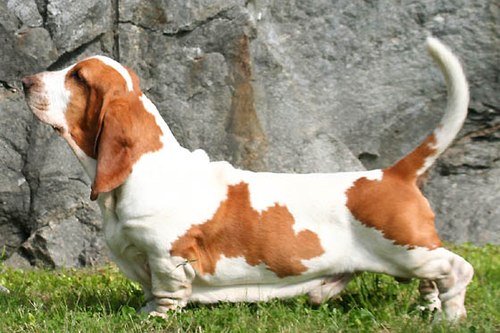
Basset Hound
Hound · Medium
- Energy
- Kids
- Shedding

German Shepherd Dog
Herding · Large
- Energy
- Kids
- Shedding

Doberman Pinscher
Working · Large
- Energy
- Kids
- Shedding
Related topics

Symptom
Swollen Belly
A swollen, tight or drum-like belly can be bloat (GDV), a life-threatening emergency in which the stomach fills with ga…

Symptom
Vomiting
One episode of vomiting in a dog who is bright, drinking and acting like their usual self is common, and acute vomiting…

Symptom
Panting
Panting is how dogs cool down, so panting after exercise, play or in warm weather is normal and eases with rest, shade…

Symptom
Lethargy
Lethargy means your dog is unusually quiet, slow or uninterested in things they normally enjoy, with no obvious reason…